
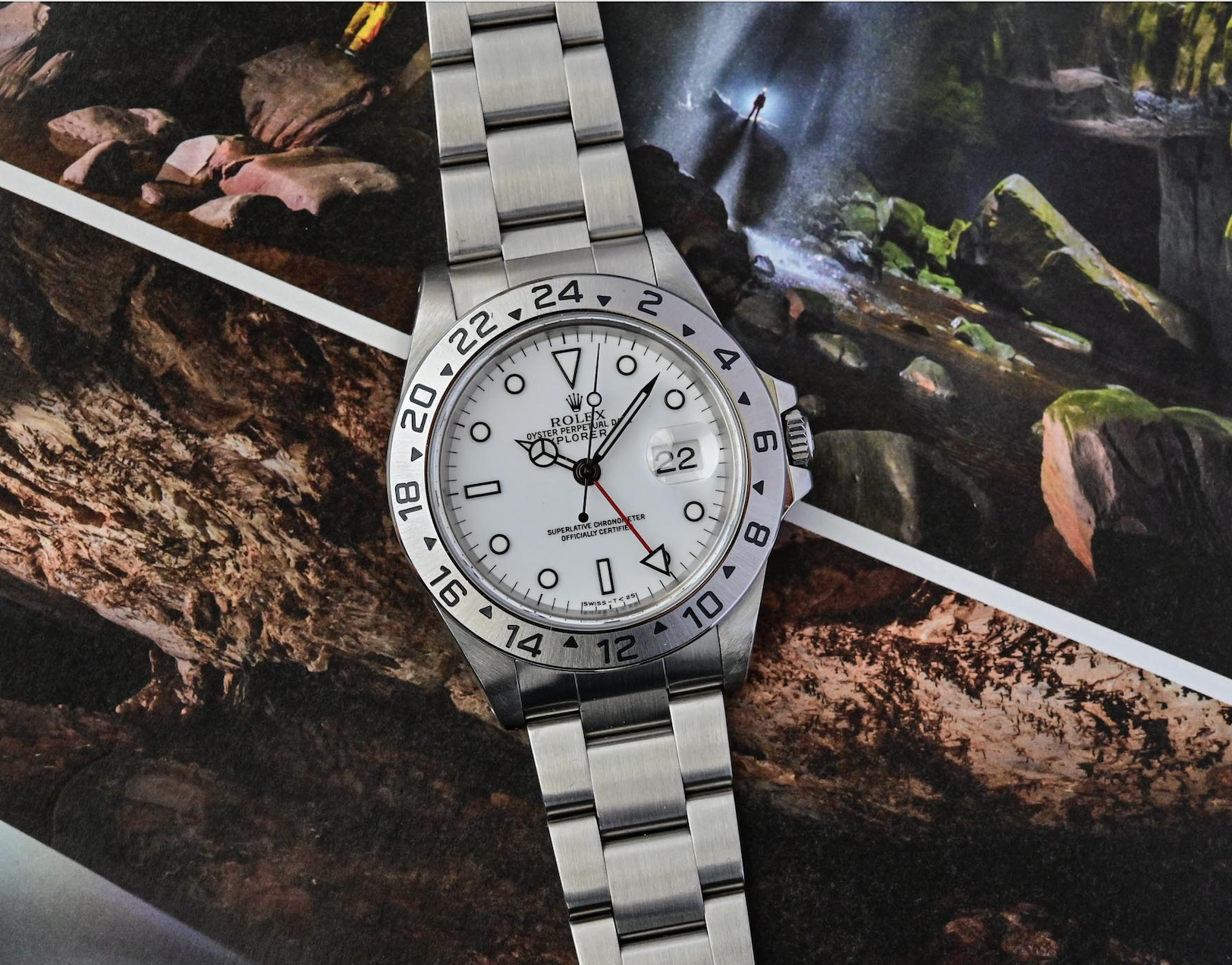
Rolex Explorer II: A Beginner’s Guide to Its Features
Key Highlights
- The Rolex Explorer II was originally designed in 1971 for cave explorers who needed to distinguish day from night.
- It features a fixed 24-hour bezel and a distinct 24-hour hand, which evolved to offer a GMT function for tracking a second time zone.
- The watch is exclusively made with a robust Oystersteel case, known for its superior corrosion resistance.
- You can choose between two dial options: a classic black dial or the highly sought-after white “Polar” dial.
- Modern versions are powered by an advanced mechanical movement with a 70-hour power reserve and Paraflex shock absorbers.
- The case size has evolved from 39mm to 40mm and now stands at a contemporary 42mm.
Introduction
Are you looking for a watch that’s as ready for adventure as you are? The Rolex Explorer II might be the perfect fit. Originally created for explorers in dark environments, this iconic timepiece has grown into one of the most versatile stainless steel sports watches available. The Explorer II combines rugged functionality with timeless style, making it ideal for everything from deep caves to daily office wear. This guide will walk you through everything you need to know about its features.
Overview of the Rolex Explorer II a robust and functional luxury tool watch
The Rolex Explorer II was introduced as a specialized addition to the Rolex Explorer family. While the original Explorer was a straightforward, rugged watch for general exploration, the Explorer II was built with a specific user in mind: the speleologist, or cave explorer.
Its unique design was intended to help those who spend long periods without sunlight. The original Explorer II featured a 24-hour hand and bezel to track daytime and nighttime hours, a feature that set it apart from the very beginning.
History and Evolution of the Rolex Explorer II
The history of the Rolex Explorer II began in 1971 with the introduction of the reference 1655. This first Explorer II model was designed for cave explorers, featuring a bright orange 24-hour hand to help distinguish between A.M. and P.M. hours in total darkness. These early vintage models are highly collectible today, known for their unique “Freccione” (Italian for “big arrow”) hand.
A major evolution occurred in 1985 with reference 16550. This model introduced a more modern aesthetic, a larger 40mm case, and a sapphire crystal. Most importantly, it featured a new movement that allowed the 24-hour hand to be set independently, transforming the watch from a simple day/night indicator into a true GMT watch capable of tracking a second time zone.
Later models continued to refine the design. For the 40th anniversary of the Explorer II in 2011, Rolex released reference 216570, which increased the case size to 42mm and brought back the iconic orange arrow hand as a tribute to the original. The collection continues to evolve, with the latest references featuring updated movements and subtle case refinements.
What Sets the Explorer II Apart From Other Rolex Watches
Unlike many other Rolex sports watches that were designed for pilots, divers, or racers, the Explorer II was created for a very specific niche: speleologists. This unique origin story gives it a distinct identity as the ultimate tool watch for those who venture into environments without natural light. Its features are purpose-built for this task.
The most noticeable difference is its fixed 24-hour engraved bezel. While the Submariner and GMT-Master have rotating bezels for tracking elapsed time or a third time zone, the Explorer II’s bezel is stationary. It works directly with the 24-hour hand to provide a clear and unwavering time reference.
Furthermore, the evolution of the Explorer II’s functionality marks a significant step. Its transition from an A.M./P.M. indicator to a full GMT watch gave it dual-time capabilities without changing its core identity. This combination of a fixed bezel and GMT function is unique among Rolex’s professional models.
Key Features of the Rolex Explorer II
The Rolex Explorer II is packed with features that make it a robust and reliable companion for any adventurer. Its design is a perfect blend of form and function, ensuring it performs flawlessly whether you’re exploring a cave or navigating a busy city.
At its heart are the 24-hour hand and fixed bezel, which together provide its signature GMT function. Over the years, Rolex has consistently upgraded the watch, equipping later models with a new movement that offers improved efficiency and a longer power reserve. Let’s look closer at these key features.
The 24-Hour Hand and Its Functionality
The 24-hour hand is arguably the most defining feature of the Explorer II. In the original 1971 model, this hand was a large, bright orange arrow, earning it the nickname “Freccione” or “big arrow.” Its primary purpose was to allow cave explorers to distinguish between day and night hours by pointing to the 24-hour scale on the bezel.
As the watch evolved, so did the hand’s functionality. It became independently adjustable, allowing it to track a second time zone. This hand makes one full rotation around the dial every 24 hours, providing an unambiguous time reference that is separate from the main 12-hour hand used for local time.
So, what can this hand do for you?
- A.M./P.M. Indication: In dark environments, it serves as a reliable day/night indicator.
- Second Time Zone: You can set it to your home time while you travel, using the main hands for local time.
- Perfect Time Keeping: It helps you coordinate between two locations, ensuring you always have the perfect time reference.
Dual Time Zone Capabilities
Starting with the reference 16550 in 1985, the Explorer II gained the ability to display a second time zone, transforming it into a fully-fledged GMT watch. This was made possible by a new caliber that allowed the main 12-hour hand to be adjusted independently without stopping the watch.
How does this work for you? You can set the prominent 24-hour arrow hand to your “home” time zone, which is read against the fixed 24-hour bezel. When you travel to a new time zone, you simply “jump” the main hour hand forward or backward in one-hour increments to reflect the new local time.
This functionality is incredibly useful for travelers, pilots, and anyone who needs to keep track of two time zones simultaneously. The minute and second hands remain synchronized with your home time, ensuring precise timekeeping across the globe. This feature makes the Explorer II a practical and powerful tool for global adventurers.
Robust Oystersteel Case and Durability
The Explorer II has always been housed in a tough stainless steel case, a hallmark of Rolex’s professional watches. This isn’t just any steel; since 1985, Rolex has used a special alloy called 904L steel, which the brand now markets as Oystersteel.
What makes Oystersteel special? This superalloy is typically used in the aerospace and chemical industries due to its exceptional durability. It provides greater resistance to corrosion and pitting than the standard 316L stainless steel used by most other watchmakers. This means your Explorer II can withstand exposure to saltwater, sweat, and other harsh elements without losing its polished finish.
The result is a stainless steel case that is not only beautiful but also incredibly resilient. The strength of Oystersteel ensures that the intricate movement inside is protected from the knocks and shocks of an adventurous life, giving you a watch that is built to last for generations.
Design Elements and Aesthetics
Beyond its technical prowess, the Rolex Explorer II boasts a clean and functional design that has captivated watch enthusiasts for decades. Its aesthetic is defined by legibility and a purposeful, tool-watch feel. A key part of its appeal lies in its distinct dial options.
Whether you prefer the classic, understated look of the black dial or the crisp, high-contrast appearance of the white “Polar” dial, the Explorer II offers a strong visual identity. We will now explore the details of its case, dial, and bracelet that make this watch a design icon.
Case Size and Profile
The case size of the Explorer II has seen a thoughtful evolution over its lifespan. The original reference started at 39mm, which was later increased to 40mm for a more modern presence on the wrist. The latest models feature a 42mm case, offering enhanced legibility and a contemporary feel while remaining comfortable for daily wear.
A key part of its robust profile is the presence of prominent crown guards. These are integrated into the side of the case to shield the screw-down winding crown from accidental bumps and impacts, a crucial feature for a watch designed for adventure. The beautiful brushed stainless steel finish on the case and bracelet reinforces its sporty, tool-watch character.
With the most recent update, Rolex refined the case proportions. The latest model features slightly thinner lugs and a wider bracelet, creating a more balanced and elegant silhouette on the wrist. These subtle tweaks demonstrate Rolex’s commitment to perfecting its designs over time.
Dial Options: Black vs. White “Polar”
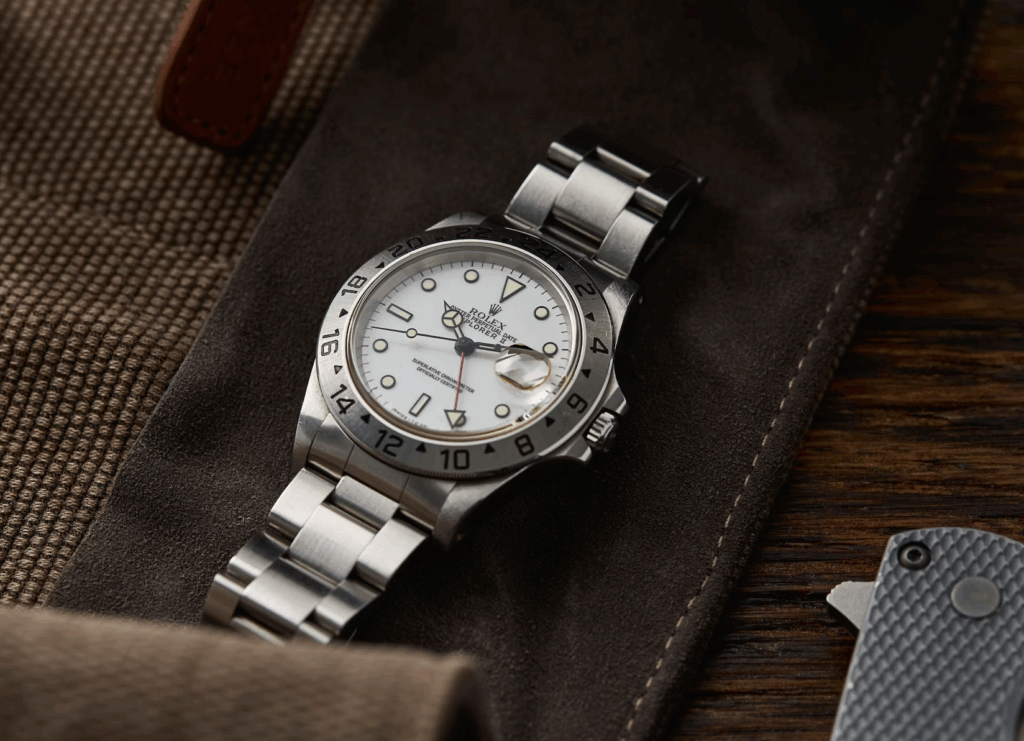
One of the most exciting choices you get to make with an Explorer II is the dial color. You can opt for a classic black dial or the iconic white dial, affectionately nicknamed the “Polar Explorer II” by collectors. Both options feature large hour markers and Mercedes-style hands for excellent readability.
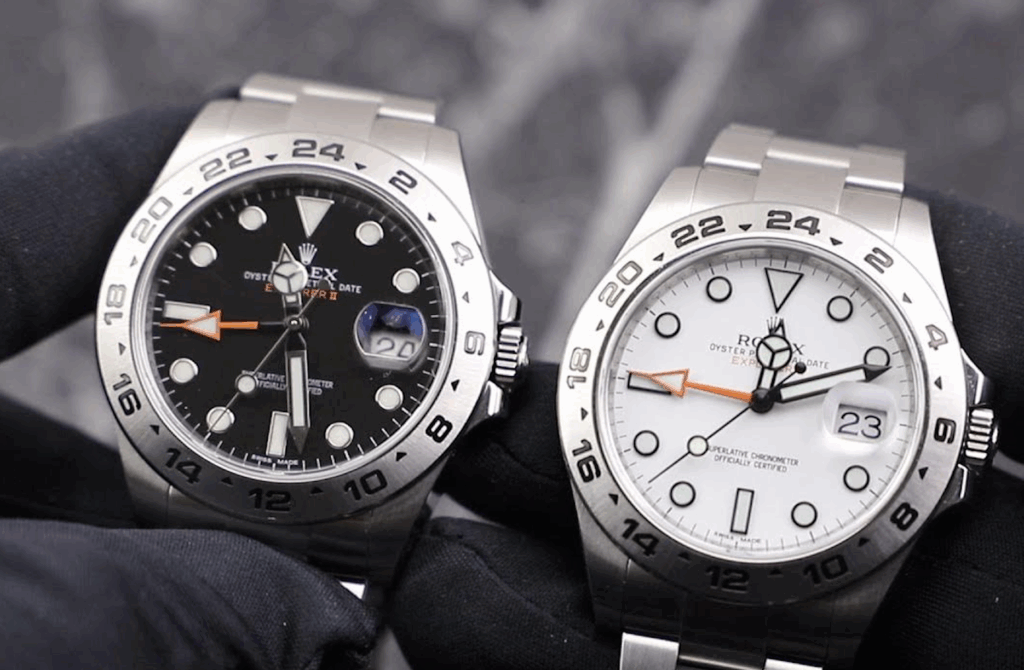
The white “Polar” dial introduced a unique design element that has become a signature of the model. To enhance contrast, the white gold hour markers are finished with a black surround, making them pop against the crisp white background. This feature is exclusive to the Polar dial and is a key reason for its popularity.
Both dial versions benefit from Rolex’s modern Chromalight display. This luminous material provides a long-lasting blue glow in the dark, ensuring the dial is perfectly legible in any lighting condition.
- Black Dial: A timeless and versatile option that aligns with other classic Rolex sports models.
- White “Polar” Dial: Offers a unique, high-contrast look with its black-outlined large hour markers, setting it apart from other Rolex watches.
Bracelet and Clasp Details
The Explorer II is fitted with Rolex’s iconic Oyster bracelet. This sporty and robust bracelet features a three-piece link design with a brushed finish that perfectly complements the watch’s tool-watch aesthetic. It’s known for being both incredibly durable and comfortable on the wrist.
For added security, the bracelet is equipped with an Oysterlock safety clasp. This clever mechanism prevents the clasp from accidentally opening, giving you confidence that your watch will stay securely on your wrist during any activity. But the innovation doesn’t stop there.
The bracelet also includes the Easylink comfort extension link, a feature that many wearers love. This patented system allows you to easily adjust the bracelet length by 5mm without any tools. This is perfect for making small adjustments on hot days when your wrist might swell, ensuring a perfect fit across a range of wrist sizes.
Performance in Extreme Environments
The Rolex Explorer II was born for adventure, and its performance in extreme conditions is a testament to its design and engineering. Built to withstand the rigors of exploration, it has become a trusted name for those who push boundaries in various environments.
From the freezing cold of arctic expeditions to the damp darkness of underground caves, this watch is designed to function reliably. Knowing your timepiece can handle whatever you throw at it provides true peace of mind. Let’s examine the specific features that ensure this remarkable performance.
Water Resistance and Sealing Technology
Every Rolex Explorer II model, from vintage to modern, comes with a water resistance rating of 100 meters (330 feet). While not a dedicated dive watch like the Submariner, this level of water resistance is more than enough to handle swimming, snorkeling, and exposure to moisture during outdoor activities.
This impressive protection is achieved through Rolex’s legendary Oyster case and its patented sealing technology. The system creates a hermetic seal by screwing the bezel, case back, and winding crown securely against the middle case. This effectively locks out water, dust, and pressure.
Topping it all off is a scratch-resistant sapphire crystal, which further protects the dial and movement. The combination of the Oyster case, screw-down Twinlock crown, and sapphire crystal ensures your watch’s heart remains safe and dry, no matter where your adventures take you.
Legibility and Luminous Markers
When you’re in a low-light environment, being able to read your watch instantly is critical. The Explorer II was designed with this principle in mind. Its dial features large hour markers, including baton markers at 6 and 9 o’clock and a prominent inverted triangle at 12 o’clock, ensuring at-a-glance readability.
Modern Explorer II models are equipped with Rolex’s proprietary Chromalight display. This innovative luminous material emits a strong, long-lasting blue glow, which is easier for the human eye to see in the dark compared to the green glow of traditional lume. It can last for up to eight hours, providing consistent and easy reading throughout the night.
This focus on legibility connects directly back to the watch’s origins. For the cave explorers it was built for, having a clear and constant time reference was a matter of safety and orientation. The combination of large hour markers and a powerful Chromalight display continues this legacy of ultimate clarity.
Endurance in Harsh Conditions
The Explorer II is built to endure. Its robust construction starts with the Oystersteel case and extends to the reliable mechanical movement within. These self-winding movements are renowned for their accuracy and durability, designed to keep ticking in even the most demanding situations.
A key innovation that enhances the endurance of modern Explorer II’s is the inclusion of Paraflex shock absorbers. This patented Rolex technology protects the delicate balance wheel—the heart of the mechanical movement—from shocks and impacts. It improves the movement’s shock resistance by up to 50%, providing crucial protection during intense physical activities.
When you combine the tough Oystersteel case, the 100-meter water resistance, and the shock-protected movement, you get a watch with incredible endurance. This is how the Explorer II performs so well in extreme environments, providing a reliable timekeeping companion you can count on.
Beginner’s Guide: Getting Started With the Rolex Explorer II
Congratulations on your interest in the Rolex Explorer II! Getting started with this remarkable watch is an exciting experience. This beginner’s guide will help you understand its basic functions and how to get the most out of your timepiece, from setting the perfect time to maintaining its performance.
One of the great features of a modern Explorer II is its impressive power reserve, with newer models offering up to 70 hours of power reserve. This means your watch will keep running accurately even if you don’t wear it for a couple of days.
What You’ll Need to Start Exploring With the Explorer II
The beauty of the Explorer II is its self-sufficiency. You don’t need any special equipment to get started. The watch is powered by an automatic mechanical movement, which means it winds itself using the natural motion of your wrist. As long as you wear it, it will keep running.
One of the most practical features for an adventurer is the watch’s long power reserve. Modern references boast up to 70 hours of power reserve, so you can take it off for a weekend and it will still be ticking when you put it back on.
This combination of features makes the Explorer II perfectly suited for exploration.
- Self-Winding Movement: No need for batteries, making it reliable in remote locations.
- Long Power Reserve: The watch keeps running for nearly three days off the wrist.
- Durable Build: It’s designed from the ground up to withstand the elements.
Step-by-Step Guide to Using the Explorer II
Operating your new Explorer II is a straightforward process. The watch’s functions are intuitive, designed for easy use whether you’re at home or on the move. Following this step-by-step guide will help you set up your watch correctly and take full advantage of its features.
From setting the time to adjusting for different time zones, each function is accessed through the winding crown. With just a few simple turns and pulls, you can have your watch perfectly configured for your needs.
Here is a quick overview of the steps you’ll follow to get your Explorer II ready for action. The following sections will explain each step in more detail.
| Step | Action |
|---|---|
| Step 1 | Setting the Time and 24-Hour Hand |
| Step 2 | Adjusting for a Second Time Zone |
| Step 3 | Maintaining Your Explorer II for Longevity |
Step 1: Setting the Time and 24-Hour Hand
Setting the time on your Explorer II is the first step to getting started. You’ll begin by unscrewing the Twinlock crown counter-clockwise until it pops free from the case. Then, gently pull the crown out to its final position (position 3). The second hand will stop, allowing you to set the time precisely.
In this position, turning the crown will move the minute hand, the 12-hour hand, and the 24-hour hand all at once. Set the hands to the correct local time, paying close attention to the 24-hour hand to ensure it corresponds with the correct A.M. or P.M. hour on the bezel.
Once you have set the initial time, you can push the crown back in one step to its second position, which will restart the second hand. This initial synchronization is key to ensuring you have the perfect time reference before you begin tracking multiple time zones.
Step 2: Adjusting for a Second Time Zone
This is where the Explorer II’s GMT function shines. When you travel to a new time zone, you don’t need to reset the entire watch. Simply unscrew the crown and pull it out to the second position. In this position, the watch continues to run, but you can now adjust the main 12-hour hand independently.
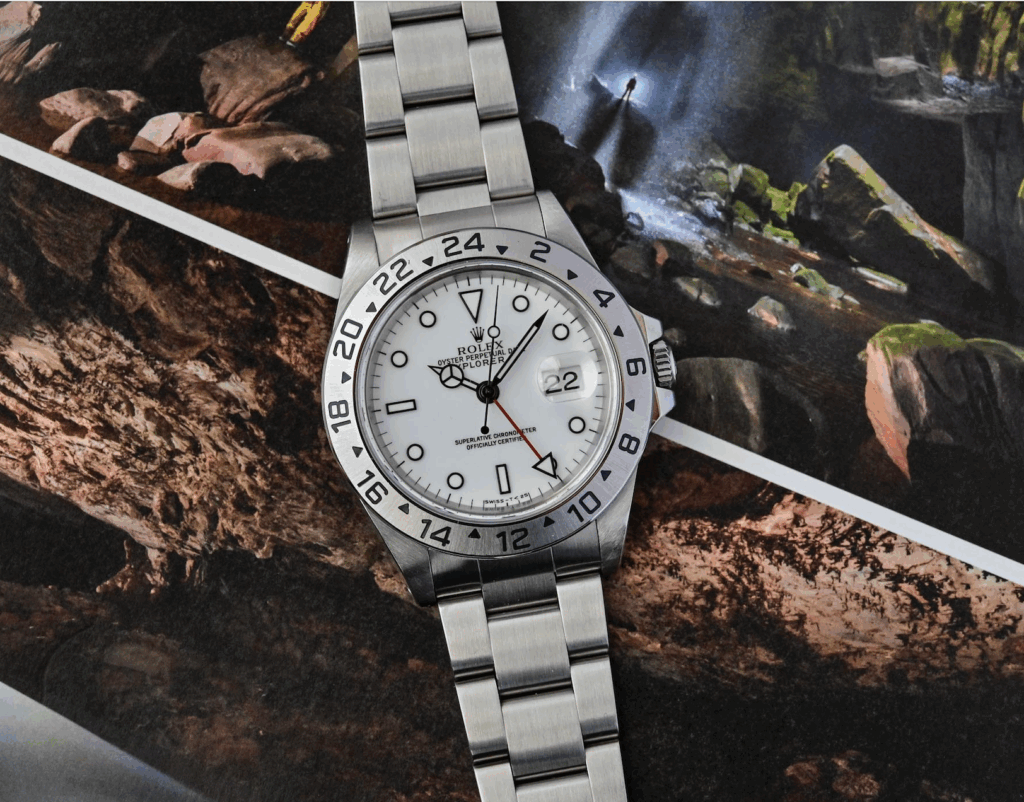
Turn the crown to “jump” the hour hand forward or backward in one-hour increments until it displays the correct local time. The date will also change automatically if you pass midnight. This “jumping hour” feature is incredibly convenient for frequent travelers.
Throughout this process, the 24-hour hand remains untouched, continuing to point to your home time on the 24-hour bezel. This allows you to track a second time zone effortlessly, which is the core of the watch’s celebrated GMT function. Once set, screw the crown back down to ensure water resistance.
Step 3: Maintaining Your Explorer II for Longevity
Maintaining your Explorer II is simple and will ensure it provides you with a lifetime of reliable service. The most important daily habit is to always make sure the screw-down crown is fully tightened against the case. This guarantees its water resistance and protects the movement from dust.
To keep your watch looking its best, you can clean it with a microfiber cloth. If it gets dirty, a gentle wash with soap and water using a soft brush is all it needs, but always double-check that the crown is screwed down first.
For long-term peace of mind and performance, follow these simple tips:
- Wear it regularly: The self-winding movement relies on your motion to maintain its power reserve.
- Keep the crown secure: Always screw the crown down tightly after setting the time.
- Schedule professional service: Rolex recommends servicing your watch approximately every 10 years to keep it in perfect working order.
Price Range and Market Value
The price range for a Rolex Explorer II can vary significantly, depending on factors like the model’s age, condition, and whether you’re buying new or pre-owned. As with many highly sought-after timepieces, market trends in the luxury watch market play a big role in determining its current market value.
Generally, due to high demand and limited supply at authorized dealers, both new and pre-owned models often trade at a premium on the secondary market. Let’s explore the typical prices you can expect.
Typical Price Range for New and Pre-Owned Models
Finding a new Rolex Explorer II at retail price can be challenging, as demand often outstrips supply. As a result, many buyers turn to the secondary market, where prices are dictated by availability and demand. On trusted platforms like Bob’s Watches, you can find a wide selection of pre-owned models.
The price for a pre-owned Explorer II depends heavily on its reference number, condition, and whether it comes with its original box and papers. For example, the white “Polar” dial versions often command a higher price than their black dial counterparts. Vintage models, especially the reference 1655, can be particularly expensive due to their rarity.
While exact prices fluctuate, here’s a general overview of what you might expect on the secondary market.
| Model Type | Typical Price on Secondary Market |
|---|---|
| New Rolex Explorer II | Often trades for thousands above its retail price |
| Pre-owned (Modern Ref.) | Prices are strong, often close to or above the retail price |
| Pre-owned (Vintage Ref.) | Highly variable, with rare models fetching premium prices |
Factors Affecting the Value of the Explorer II
The market value of a Rolex Explorer II isn’t fixed; it’s influenced by several key factors, much like other investment-grade luxury watches from brands like Patek Philippe. Understanding these factors can help you appreciate why some models are more sought-after than others.
For vintage models, rarity is a primary driver of value. Certain dial variations, transitional references that were produced for a short time, and watches in exceptional original condition are highly prized by collectors. Later models are valued for their modern technology and pristine condition. General market trends, especially the high demand for stainless steel sports watches, also play a huge role.
Here are the main factors that affect the Explorer II’s value:
- Reference and Rarity: Vintage models like the ref. 1655 and short-lived transitional references are often the most valuable.
- Dial Type: The white “Polar” dial typically commands a premium over the black dial.
- Condition and Completeness: A watch in excellent condition with its original box and papers will always be worth more.
Conclusion
In conclusion, the Rolex Explorer II is not just a timepiece; it’s a tool designed for adventure and exploration. With its unique features—such as the 24-hour hand, dual-time zone capabilities, and robust construction—it stands out in the world of luxury watches. Whether you’re trekking through the mountains or navigating city streets, this watch is built to endure challenging conditions while providing exceptional functionality. For beginners, understanding its features and how to maintain it ensures you make the most out of your investment. If you’re ready to take the plunge into the world of the Rolex Explorer II, get in touch with us for a free consultation to find the perfect model that suits your exploratory spirit!
Frequently Asked Questions
Why Is the Rolex Explorer II Considered a True Tool Watch?
The Rolex Explorer II is considered the ultimate tool watch because it was designed with a specific purpose in mind. Its robust construction, highly legible dial, fixed 24-hour bezel, and GMT function were all engineered for explorers in extreme environments, making it a functional and reliable instrument rather than just a piece of jewelry.
What Makes the Explorer II Durable Compared to Other Models?
The Explorer II’s durability comes from its use of Oystersteel, a 904L stainless steel alloy that offers greater resistance to corrosion and impacts than the steel used in many other watches. Combined with the hermetically sealed Oyster case and a scratch-resistant sapphire crystal, it is one of the most resilient Rolex watches available.
Is the Explorer II Suitable for Adventure Activities?
Absolutely. The Explorer II is built for adventure. Its durable case, 100-meter water resistance, and shock-resistant mechanical movement make it ideal for extreme conditions. With a long power reserve and a highly legible dial, it’s a reliable companion for hiking, climbing, traveling, and exploring off the beaten path.
Why Is the Explorer II Sometimes Described as Underrated?
The Explorer II was historically considered underrated because it was often overshadowed by more famous Rolex sports watches like the Submariner and GMT-Master. However, its unique features, like the Polar Explorer II dial and the history of its vintage models, have gained significant appreciation, making it a collector’s favorite today.
https://www.watchuseek.com/threads/wrists-to-small-for-a-rolex.379265
https://www.watchuseek.com/threads/new-rolex-explorer-ii-dimensions.5311021
https://www.rolex.com/watches/explorer.html
https://www.trustpilot.com/reviews/641dfea6c4604c1d4c730973
https://newsroom.rolex.com/watchmaking/excellence-in-the-making
https://www.crownandcaliber.com/collections/rolex-watches
Leave a Reply