
Explore the Legacy of Ferdinand Berthoud’s Masterpieces
Key Highlights
- Ferdinand Berthoud’s roots go back to an 18th century master watchmaker known for marine chronometers.
- The modern maison revives that spirit through mesure du temps, precise chronometry, and very low production. To stay informed about the latest updates on ferdinand berthoud watches, you can follow their official social media accounts. Ferdinand Berthoud is active on platforms such as Instagram and Facebook, where they showcase new releases, insights on chronometers, and stories from their master watchmaker heritage.
- The modern maison revives that spirit through mesure du temps, precise chronometry, and very low production.
- Its watches stand out in haute horlogerie for chain transmission systems, remontoirs, and cylindrical balance springs.
- Signature designs include octagonal cases, sapphire portholes, and carefully chosen case materials.
- Awards such as the Aiguille d’Or confirm the brand’s rare standing among collectors.
Ferdinand Berthoud’s name carries real weight in watchmaking and horology. First, it belongs to one of the great figures of precision timekeeping in the 18th century. Today, it also represents a modern manufacture focused on highly technical chronometers made in very small numbers. If you want to understand why collectors speak about these watches with such respect, you need to look at both the history and the modern creations. That story starts with legacy, then moves into design, craft, and performance.
The Legacy of Ferdinand Berthoud in Watchmaking
Ferdinand Berthoud was one of the defining names in 18th century precision timekeeping. In France, Berthoud rose quickly, earning recognition as a master watchmaker at just 26. His work was tied to serious practical needs, especially accurate time at sea.
Just as important, his published writings helped pass on knowledge about mesure du temps to later generations. That mix of hands-on innovation and written teaching explains why his name still matters. To see the full picture, it helps to start with his life and then his technical breakthroughs.
Biography and Historical Significance
Ferdinand Berthoud’s story begins in 1727 in the Val-de-Travers, in present-day Switzerland. He later rose to prominence in Paris, where he became a leading watchmaker of his era. In 1753, he received the title of master watchmaker from the council of Louis XV, a remarkable achievement for someone only 26 years old.
His importance grew even further in 1770, when he was appointed Horologist-Mechanic to the King and Navy of France. That role linked his work directly to the French Navy and to the challenge of finding longitude at sea with reliable marine timekeepers.
Berthoud’s marine clocks guided French vessels across the oceans, placing him among the great practical minds of horology. His published research also made his ideas reproducible, which is rare. While the compiled record ties sea exploration to the wider age of the discoveries of James Cook, Berthoud’s own significance rests on turning precision timing into something nations could use.
Innovations That Shaped Horology
What set Berthoud apart was not style alone. It was function. His marine chronometers were tools built to solve the problem of longitude, one of the great navigational challenges of the time. That practical value gave his work lasting importance in mesure du temps.
The modern manufacture reflects that same focus on chronometry through complex systems inspired by historic solutions. Rather than chasing easy prestige, it builds watches around serious mechanisms and low-volume production.
- Marine chronometers formed the historic foundation of the Berthoud name.
- Modern movements use chain transmission systems, remontoirs, and other chronometers-focused architecture.
- The maison builds contemporary watches as if precision still comes first, not convenience.
That is a big part of what makes Ferdinand Berthoud watches stand out in luxury timepieces. They are rooted in a real technical legacy, not just a revived label.
Hallmarks of Ferdinand Berthoud Timepieces
You can spot a Ferdinand Berthoud timepiece by its balance of engineering and visual identity. In haute horlogerie, many brands focus on finishing or rarity alone. Here, watchmaking substance leads the design.
That approach has earned unusual recognition, including repeated success at the Grand Prix d’Horlogerie de Genève. Awards matter, but the watches themselves explain the praise. Their cases, displays, and construction all reflect a clear philosophy. The next sections show how design details and craft methods shape that character.
Distinctive Design Philosophy
A Ferdinand Berthoud watch does not look generic. Early models used a bold octagonal shape with sapphire portholes on the sides of the case. That choice gave owners a better view of the movement while making the watch instantly recognizable. Later collections expanded into round cases, but the emphasis on architecture stayed strong.
The dial layouts also show purpose. Some models use regulator-style displays, others central time, and some shift major technical elements to the front. In contemporary haute horlogerie, that kind of visual honesty feels refreshing.
| Design Element | What It Adds |
|---|---|
| Portholes | Side views into the movement and strong identity |
| Dial layout | Clear focus on chronometry and function |
| Case material | Changes weight, color, and personality |
| Sides of the case | Turn the watch into a three-dimensional object |
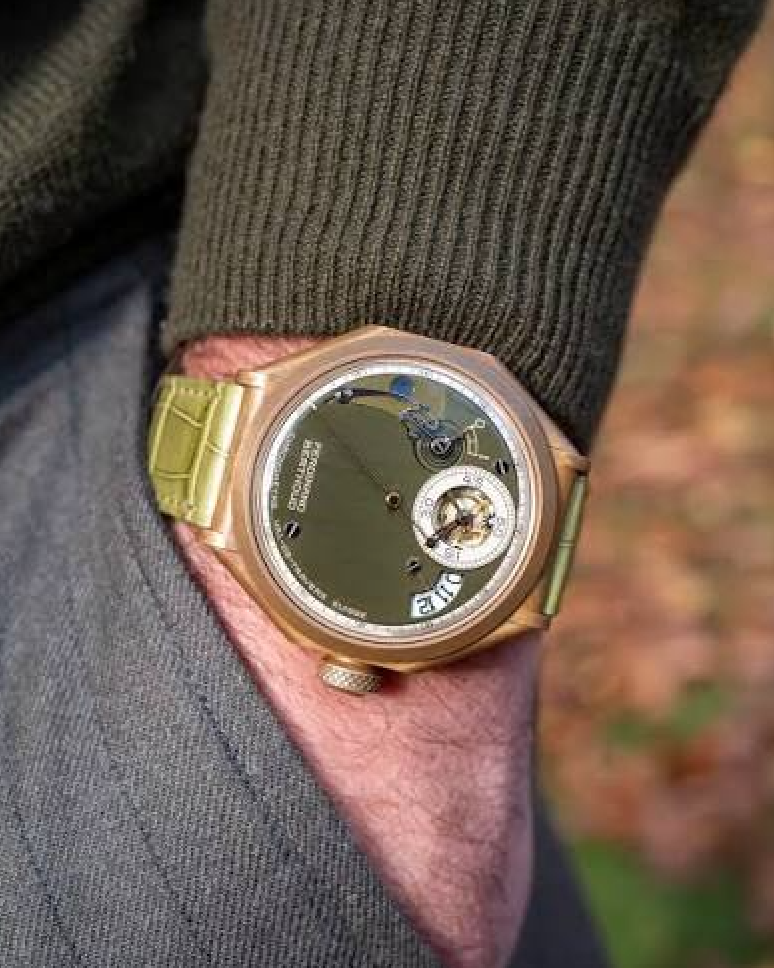
A patinated bronze case adds appeal because no two examples age in exactly the same way. The surface develops character over time, giving the watch a more individual presence.
Exclusive Craftsmanship Techniques
The modern manufacture was founded in Fleurier by Karl-Friedrich Scheufele, co-president of Chopard, but it operates with its own identity and standards. One of its strengths is the willingness to invest years into movement development instead of chasing volume. That patience shows across the collections.
Projects such as Naissance d’une Montre push this even further by preserving endangered hand-making skills. The result is not just another expensive wristwatch. It is a demonstration of how traditional methods and new techniques can live together.
- In Fleurier, production remains extremely small, with watches essentially made to order.
- Naissance d’une Montre centers on near-total hand-craft and skill transmission.
- The manufacture develops in-house calibers built around chronometry, not shortcuts.
That combination is why collectors see the brand as special. Few names in this space balance historical seriousness, technical ambition, and hand-made discipline so well.
The Chronomètre FB 1R5-5: A Showpiece of Precision
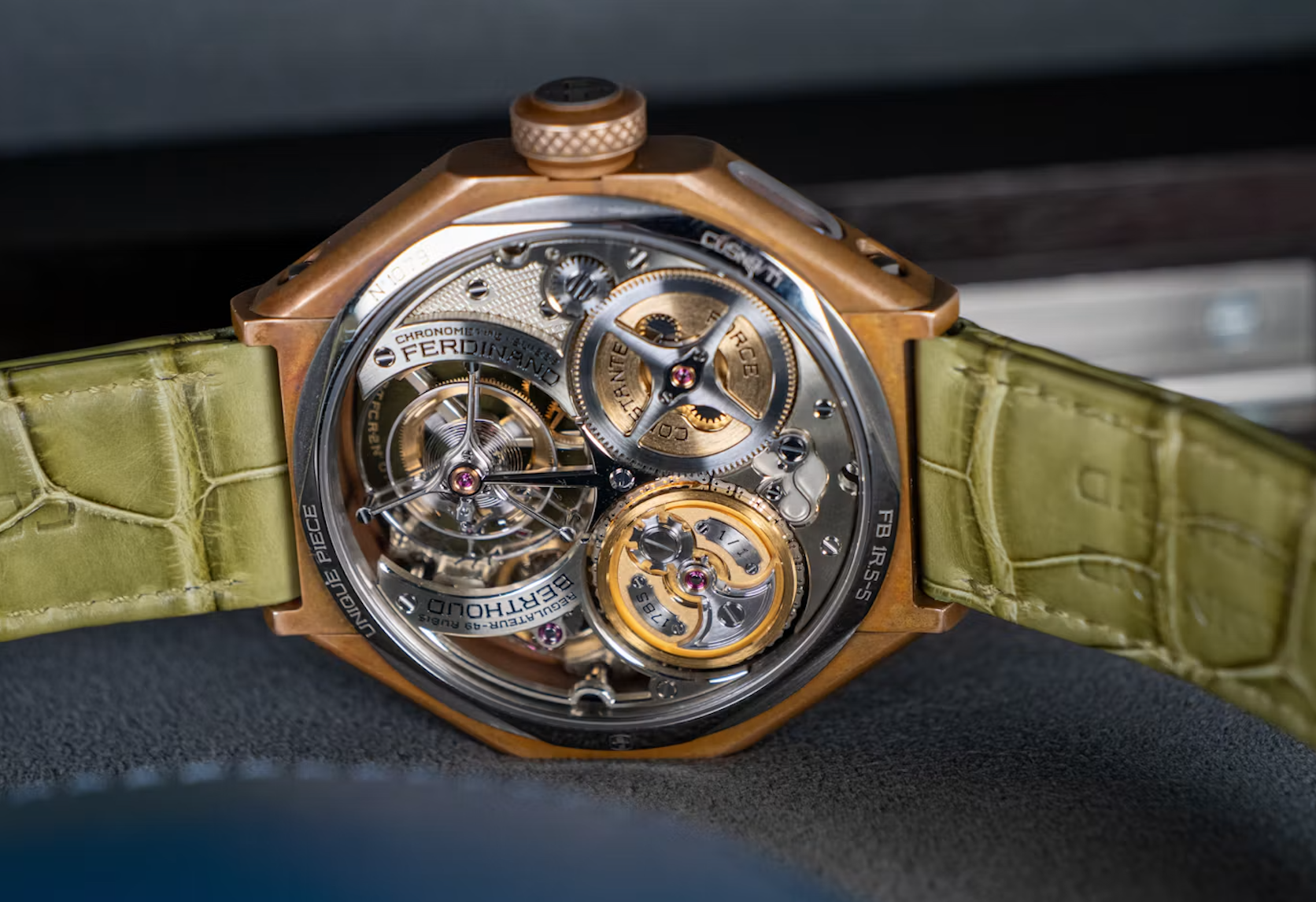
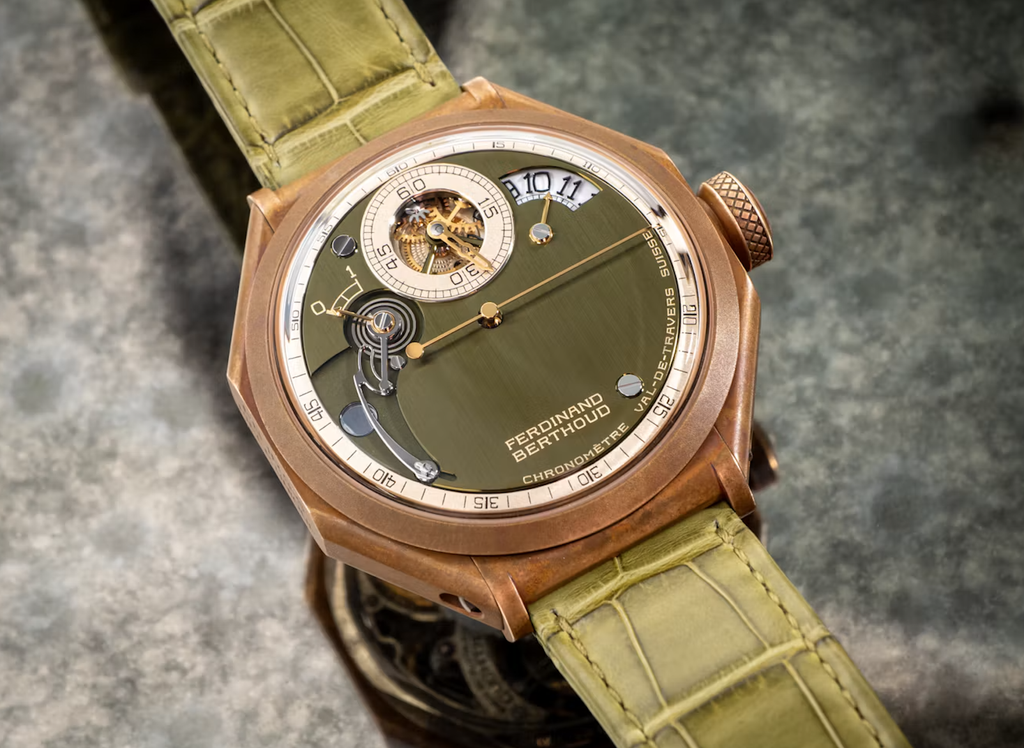
Among early Ferdinand Berthoud FB creations, the Chronomètre FB 1R.5 family holds a special place. It belongs to the regulator line and shows how the brand approached chronometry with a strong visual identity. These watches came in a very limited patinated bronze case series, with only five made.
That rarity alone draws attention, but the technical base matters more. The FB 1 era established the maison’s reputation, and the broader line quickly led to honors like the Aiguille d’Or. To understand the FB 1R5-5, look at its mechanics first, then its collector appeal.
Technical Features and Complications
The Ferdinand Berthoud Chronomètre FB 1R.5 is part of the regulator branch introduced in 2017. Instead of placing the hour and minute hands together, it separates indications for a more instrument-like feel. This fits the brand’s emphasis on chronometers and precision-focused display choices.
Its movement architecture follows the early FB 1 formula: an octagonal case, tourbillon-based chronometry, and fusée-and-chain style chain transmission. Across the FB 1 family, the power reserve indicator is a recurring functional element, and that contributes to the technical character collectors expect from the brand.
- Regulator display with separate time indications
- Octagonal case architecture with side portholes
- Chain transmission system linked to advanced chronometry
Other FB 1 references also explored titanium, precious metals, and different display treatments. In the FB 1R.5, the patinated bronze execution gives these technical ideas a warmer, more individual exterior.
Collectors’ Perspective on the Chronomètre FB 1R5-5
Collectors tend to place Ferdinand Berthoud in a rare category within luxury watches. It is not treated as a mass-status name. Instead, it is seen as a connoisseur’s brand, built for people who care about movement architecture, chronometry, and genuine historical links.
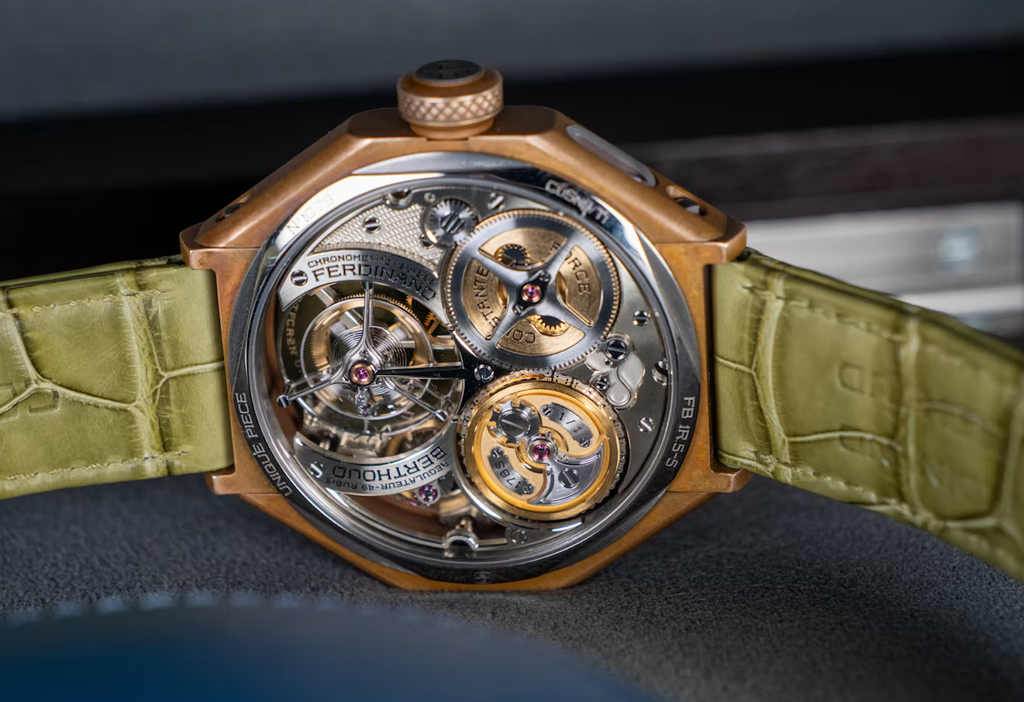
The FB 1R5-5 reflects that reputation well. Its unusual case material makes it memorable, but not flashy in a conventional sense. A patinated bronze case changes over time, so each example feels personal. When only five were made, that individuality becomes even more meaningful.
Compared with other haute horlogerie names, Ferdinand Berthoud often earns respect for doing less, but doing it at a very high level. Some collectors may compare it with houses connected to Chopard or even broader references in the market, yet the appeal here is tighter: low production, technical seriousness, and distinct identity.
Celebrated Editions and Unique Pieces
Some Ferdinand Berthoud releases go beyond regular production and become statements of tribute, research, or preservation. These watches show how the brand uses small editions and one-off creations to express its deeper values, not just exclusivity.
That is why collectors follow them so closely. Between award-winning credibility tied to the Grand Prix d’Horlogerie and an output of only a few dozen watches each year, special editions carry real weight. Two strong examples are the Edition 1785 concept and a remarkable unique timepiece shaped by years of work.
Inside the Ferdinand Berthoud Edition 1785
The idea behind edition 1785 naturally connects to Berthoud’s historical world and to mesure du temps as a serious scientific pursuit. The modern maison already uses that heritage clearly in the Mesure du Temps 1787 collection, named after Berthoud’s major treatise. Any Edition 1785 framing fits the same spirit of historical tribute rather than decorative nostalgia.
What makes these historically minded pieces compelling is the way they link Switzerland and France. Berthoud was born in the Val-de-Travers, then built his fame in Paris and served the Navy of France through marine precision instruments.
- The appeal lies in direct ties to Berthoud’s era and published work.
- The historical link spans both Switzerland and France.
- The naval connection strengthens the tribute through the Navy of France legacy.
So when people ask about the unique aspects of an edition 1785 concept, the answer is simple: it is meaningful because the brand’s history is real, technical, and deeply anchored in timekeeping at sea.
The Eight-Year Pièce Unique: Creation and Story
The most powerful story in this area is the brand’s commitment to long-form creation. The compiled record describes projects lasting six years and emphasizes development campaigns carried out in secrecy or over extended periods. That tells you a lot about the maison’s pace. It does not rush.
A pièce unique associated with an eight-year journey fits that broader method. In this world, a unique timepiece is not special because it is merely scarce. It matters because its creation reflects patience, hand-craft, and the refusal to simplify difficult work for the sake of speed.
That is why such a watch feels like a true tribute to haute horlogerie values. The point is not spectacle alone. It is the discipline behind the object. When Ferdinand Berthoud builds something rare, the rarity usually comes from time, technical challenge, and purpose.
Frequently Asked Questions
Curiosity often surrounds the artistry of watchmaking, particularly with regards to Ferdinand Berthoud’s illustrious creations. Questions about the marine chronometers and their accuracy in mesure du temps frequently arise. Enthusiasts often inquire about the significance of the aiguille d’or awards that honor exquisite craftsmanship. Others are keen to understand the innovations in chain transmission and power reserve indicators that define haute horlogerie. As the journey through Berthoud’s legacy continues, numerous discoveries from the 18th century still resonate within contemporary luxury watches.
Where can I view or purchase Ferdinand Berthoud watches?
You can view the full collection online through brand listing and collection pages that track current Ferdinand Berthoud models. The manufacture is based in Fleurier, Switzerland, with historical ties to France, and its revival came through Karl-Friedrich Scheufele of Chopard. These luxury watches are produced in very small numbers.
What materials are used in Ferdinand Berthoud watch cases?
Case material choices include white gold, rose gold, platinum, stainless steel, titanium, ceramicized titanium, and patinated bronze. Those materials shape both feel and appearance, while the sides of the case often add visual drama through portholes or sculpted architecture. The bronze versions gain extra character as they age.
How does Ferdinand Berthoud compare with other luxury watch brands?
Among luxury watches, Ferdinand Berthoud is viewed as a specialist name for serious collectors. Its haute horlogerie standing comes from chronometry, low production, and in-house mechanics. Unlike broad-market names such as Seiko, it serves a very narrow top tier. Its modern revival is linked to Chopard, but its identity remains distinct.
Conclusion
In summary, Ferdinand Berthoud’s masterpieces represent an intricate blend of history, innovation, and unparalleled craftsmanship that has left a mark on the world of horology. From his groundbreaking contributions to watchmaking to the exquisite details found in each timepiece, Berthoud’s legacy continues to inspire collectors and enthusiasts alike. Whether exploring the technical marvels of the Chronomètre FB 1R5-5 or the unique stories behind celebrated editions, there’s a depth to these watches that captivates. If you’re intrigued by the artistry and precision of Ferdinand Berthoud’s creations, we invite you to explore our collection and discover the timeless elegance they offer.
https://www.exquisitetimepieces.com/collections/grand-seiko
https://www.idref.fr/033795339
https://www.thenakedwatchmaker.com/decon-ferdinand-berthoud
Leave a Reply